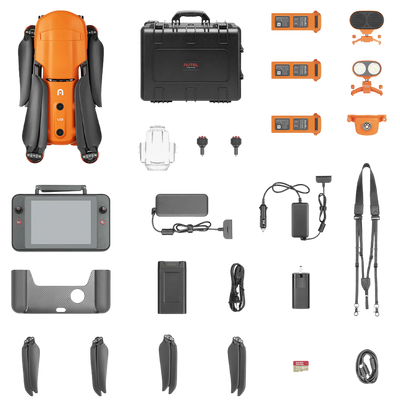
The DJI Matrice 4E and Matrice 4T look almost identical — same compact airframe, same 49-minute flight time, same flagship transmission. The difference is what's on the gimbal, and that single choice decides which missions each drone is built for. Here's how they compare, using official DJI specifications, so you can spec the right one the first time.
The short answer
Choose the Matrice 4E if your work is surveying and mapping: it carries a larger 4/3-inch, 20 MP wide camera built for high-accuracy photogrammetry. Choose the Matrice 4T if you need thermal — inspection, public safety, search and rescue — because it adds a 640 × 512 radiometric infrared camera the 4E doesn't have. Almost everything else is the same.
Specifications at a glance
| Specification | DJI Matrice 4E | DJI Matrice 4T |
|---|---|---|
| Wide camera | 4/3-inch CMOS · 20 MP | 1/1.3-inch CMOS · 48 MP |
| Medium tele camera | 1/1.3-inch CMOS · 48 MP | 1/1.3-inch CMOS · 48 MP |
| Tele camera | 1/1.5-inch CMOS · 48 MP | 1/1.5-inch CMOS · 48 MP |
| Thermal (infrared) camera | — none | 640 × 512, uncooled VOx |
| Laser rangefinder | Up to 1800 m | Up to 1800 m |
| Max flight time | 49 min (standard props) | 49 min (standard props) |
| Takeoff weight | 1219 g | 1219 g |
| Max wind resistance | 12 m/s | 12 m/s |
| Obstacle sensing | Omnidirectional binocular vision + 3D infrared | Omnidirectional binocular vision + 3D infrared |
| RTK accuracy | 1 cm + 1 ppm (H) · 1.5 cm + 1 ppm (V) | 1 cm + 1 ppm (H) · 1.5 cm + 1 ppm (V) |
| Transmission (O4 Enterprise) | Up to 25 km (FCC) | Up to 25 km (FCC) |
Source: official DJI Matrice 4 Series specifications.
The real difference: the wide camera and thermal
Both drones carry the same 48 MP medium-tele and tele cameras, so for zoomed detail work they perform alike. The split is in two places:
- Wide camera: the 4E uses a larger 4/3-inch, 20 MP sensor. In mapping, sensor size and geometry matter more than raw megapixels — a larger sensor captures cleaner, more accurate imagery for photogrammetry and orthomosaics. The 4T's wide camera is a smaller 1/1.3-inch, 48 MP sensor tuned for general visual capture.
- Thermal: only the 4T carries a 640 × 512 radiometric infrared camera. If you need to see heat — electrical faults, roof moisture, missing persons, solar hot spots — the 4T is the only one of the two that can do it.
What they share
This is where the Matrice 4 Series makes the decision easy: outside the wide camera and thermal, the two are effectively the same aircraft. Identical 49-minute flight time, 1219 g takeoff weight, 12 m/s wind resistance, the same omnidirectional binocular vision with a 3D infrared sensor for obstacle avoidance, the same centimetre-level RTK accuracy, the same 1800 m laser rangefinder, and the same O4 Enterprise transmission with up to 25 km range (FCC). Training, batteries and workflow carry straight across.
Which one should you choose?
Choose the Matrice 4E if: your core work is surveying, mapping, land management, construction progress or any geospatial deliverable where positional accuracy and clean wide-angle imagery drive the result.
Choose the Matrice 4T if: you run inspections, public safety, search and rescue, firefighting, solar or electrical work — anything where seeing heat is the job. You keep the strong visual and zoom cameras and add radiometric thermal on top.
Not sure, or need both? Many operations run a 4T as the do-everything inspection platform and add a 4E when mapping volume justifies the dedicated survey camera. If you'd like help matching the aircraft — and the right dock, batteries and care plan — to your workflow, our team is happy to spec it with you.
Explore both at Scanixx
- DJI Matrice 4E – mapping & survey
- DJI Matrice 4T – thermal & inspection
- Request a custom quote and we'll match the platform to your operation.
All Scanixx drones are genuine, US-based stock with expert support and insured shipping.