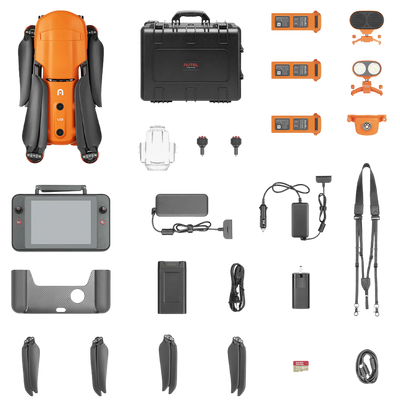
A standard camera shows you what something looks like. A thermal camera shows you what something is doing. That difference matters enormously when you are inspecting a solar farm at night, searching for a missing person in a forest, or checking a roof for heat loss before winter. Thermal drones have moved from specialist military hardware to practical professional tools, and the models available in 2025 are more capable, more affordable, and easier to operate than at any point before.
At Scanixx, we carry the leading thermal drone platforms from DJI and Autel, including the DJI Matrice 4T, Matrice 4TD, and the Autel EVO II Dual 640T. This guide explains what thermal imaging actually does, which drone suits which application, and how to choose the right platform for your operation.
What Is a Thermal Drone and How Does It Work?
A thermal drone carries an infrared camera alongside a standard optical camera. The infrared sensor detects heat radiation emitted by objects rather than reflected light. Every object with a temperature above absolute zero emits this radiation, and the drone's thermal sensor converts those differences in radiation into a visible image where warmer areas appear bright and cooler areas appear dark.
The practical result is that thermal drones can see things invisible to a standard camera. A hot spot on a circuit breaker panel, a wet patch on a flat roof, a person lying still in tall grass at 2am, or a hairline crack in a wind turbine blade that has started to generate friction heat. None of these show up on a normal video feed. All of them show up clearly on a thermal one.
Modern professional thermal drones combine both sensors in a single payload, so operators see the thermal image and the optical image simultaneously. This dual-sensor approach makes it far easier to pinpoint the exact location of a problem on a structure rather than guessing from a heat blob alone.
Why Thermal Drones Are Replacing Traditional Inspection Methods
Traditional inspection of infrastructure relies on people getting close to the asset. Roof inspectors walk on roofs. Solar farm technicians use handheld meters on individual panels. Pipeline maintenance crews drive roads and use binoculars. Each of these approaches is slow, expensive, and carries risk.
A thermal drone changes the economics completely. A single operator flying a thermal drone can inspect a 1 MW solar farm containing over 3,000 panels in a few hours, versus a ground crew taking several days. A roof inspection that requires scaffolding or a cherry picker takes an afternoon to set up and an hour to fly. Bridge and tower inspections that previously required specialist rope access can be completed in a fraction of the time with zero personnel at height.
Industry figures consistently show that thermal drone inspections reduce time by up to 70 percent and costs by 40 to 60 percent compared to manual methods. For commercial operators running inspection services, that cost reduction is the business case. For asset owners doing in-house inspection, it is a direct reduction in maintenance overhead.
DJI Matrice 4T: The Professional Compact Thermal Drone
Who It Is Built For
The Matrice 4T is DJI's compact flagship for professional thermal inspection work. It carries four sensors in a single integrated body: a wide optical camera, a zoom optical camera, a thermal infrared camera, and a laser rangefinder. This multi-sensor setup makes it the right tool for inspection teams who need fast deployment, high image quality, and the flexibility to switch between sensor types mid-mission without landing or swapping payloads.
Key Specifications and Features
- Thermal Sensor: 640x512 resolution radiometric infrared
- Optical Cameras: wide-angle and 56x hybrid zoom
- Laser Rangefinder: accurate distance measurement to inspected surfaces
- Transmission Range: up to 20 km with O4 Enterprise transmission
- Flight Time: up to 42 minutes
- Wind Resistance: up to 12 m/s
- IP Rating: IP54 dust and splash resistance
- NDAA Compliant: yes
- Use Cases: solar inspection, roof inspection, electrical infrastructure, search and rescue
What Makes the Matrice 4T Stand Out
The 56x hybrid zoom on the optical camera means operators can identify specific faults on structures from a safe standoff distance. Combine that with the simultaneous thermal feed and you get a workflow where you spot the heat anomaly on the thermal sensor, then zoom in with the optical to confirm and document it with enough detail for a written report. That two-step confirmation process is what professional inspection workflows require and what most single-sensor drones cannot provide.
Shop the DJI Matrice 4T at Scanixx: scanixx.com/products/dji-matrice-4t-thermal-intelligent-multi-sensor-compact-drone
DJI Matrice 4TD: Thermal Inspection with Dock Compatibility
Who It Is Built For
The Matrice 4TD is the dock-compatible version of the Matrice 4T. It is designed for automated inspection programs where the drone is permanently stationed on a DJI Dock 2 unit and flies pre-planned missions on a schedule, without any operator present on site. This makes it the right choice for utilities, large solar farms, pipelines, and any asset that needs regular periodic inspection rather than one-off surveys.
Key Specifications and Features
- Dock Compatibility: works with DJI Dock 2 for fully automated deployment
- Thermal Sensor: same 640x512 radiometric infrared as the 4T
- Transmission: O4 Enterprise, up to 20 km
- Mission Type: fully autonomous with schedule-based flight programs
- Use Cases: routine infrastructure monitoring, solar farm monitoring, perimeter security, pipeline surveillance
The Case for Automated Thermal Inspection
For large assets that need inspection quarterly or monthly, the economics of sending a crew every time become difficult to justify. A Dock 2 with a Matrice 4TD installed at a substation, wind farm, or large solar installation runs those missions automatically and uploads the thermal data for analysis. Problems are caught early, inspection records are complete, and no crew is dispatched until there is actually something to act on.
Shop the DJI Matrice 4TD at Scanixx: scanixx.com/products/dji-matrice-4td-includes-dji-rc-plus-2
Autel EVO II Dual 640T Enterprise: The NDAA-Compliant Thermal Platform
Who It Is Built For
The Autel EVO II Dual 640T is the thermal drone of choice for operators who need NDAA compliance as a hard requirement. Government contractors, public safety agencies, utilities receiving federal funding, and anyone working on federally sensitive infrastructure will often have restrictions that rule out DJI products by policy. The 640T fills that gap without compromising on thermal imaging quality.
Key Specifications and Features
- Thermal Sensor: 640x512 radiometric FLIR Boson thermal camera
- Optical Camera: 8K visible light camera with 16x zoom
- NDAA Compliant: yes, manufactured without restricted components
- Dual Feed: simultaneous thermal and visible light output
- Flight Time: up to 42 minutes
- Use Cases: government inspection, law enforcement, public safety, utilities
The NDAA Compliance Advantage
The 640T uses a FLIR Boson thermal core, which is an American-made sensor with a long track record in defense and public safety applications. For procurement officers who need to justify their equipment choices to agency leadership, that provenance matters. The combination of NDAA compliance, 8K optical, and 640x512 thermal in a single aircraft gives government operators a platform that meets policy requirements without sacrificing the capability needed for real inspection work.
Shop the Autel EVO II Dual 640T at Scanixx: scanixx.com/products/autel-robotics-evo-ii-dual-640t-enterprise-bundle-v3
Thermal Drone Applications: Where the Technology Makes the Biggest Difference
Solar Panel Inspection
Dirt, cell delamination, bypass diode failure, and shading mismatches all show up as hot spots on a thermal scan. Studies consistently show that faulty panels run 5 to 40 degrees hotter than healthy ones. A thermal drone identifies those underperforming panels in a single pass, letting maintenance teams target replacements precisely rather than testing each panel individually. For a large solar farm, this turns a multi-day ground inspection into a few hours of flight time.
Roof and Building Inspection
Flat roofs hold water in places where the insulation or membrane has failed. These wet areas retain heat differently from dry sections and show up clearly on a thermal scan. For property managers, insurers, and building surveyors, a thermal drone flight over a commercial roof at dusk reveals moisture intrusion that would take weeks to manifest as visible interior damage. Catching it early saves a disproportionate amount in repair costs.
Electrical Infrastructure
Overloaded or failing components in electrical systems generate heat before they fail visibly. Thermal drones inspect substations, transmission towers, switchgear, and industrial electrical panels from the air, identifying components running hotter than specification before they trip breakers, cause fires, or fail during peak demand. This type of predictive maintenance inspection is one of the fastest-growing applications in the thermal drone market.
Search and Rescue
Human bodies emit heat reliably at around 37 degrees Celsius. Against a cold ground background at night or through woodland canopy, a thermal drone picks up a person's heat signature at distances that make it effectively impossible to find them any other way. Search and rescue teams using thermal drones consistently report finding subjects in a fraction of the time compared to ground search operations alone.
Firefighting Support
Thermal drones map the active perimeter of a fire, identify hot spots that have not yet broken into visible flames, and locate missing firefighters in smoke-filled environments where radio communication has failed. For incident commanders, a thermal drone overhead provides situational awareness that fundamentally changes how suppression resources are deployed.
Choosing the Right Thermal Drone for Your Operation
Choose the DJI Matrice 4T if:
- You need a compact, fast-deploying thermal drone for varied inspection work
- Multi-sensor capability (thermal, wide, zoom, laser) in a single aircraft matters to your workflow
- You want DJI's ecosystem for flight planning, data management, and support
- Your operation does not have hard NDAA restrictions
Choose the DJI Matrice 4TD if:
- You need automated, scheduled inspection of a fixed asset
- Dock-based deployment without an operator on site fits your use case
- You run a monitoring program that requires regular repeatable data over time
Choose the Autel EVO II Dual 640T if:
- NDAA compliance is a non-negotiable requirement for your contracts or agency policy
- You need a FLIR-based thermal sensor with a proven public safety track record
- You work in law enforcement, government inspection, or federally funded infrastructure
Frequently Asked Questions About Thermal Drones
Note: Add FAQ Schema markup to this section in Shopify for Google rich results.
What is the best thermal drone for inspection in 2025?
For general professional inspection, the DJI Matrice 4T is the best-performing compact thermal drone available in 2025. Its four-sensor array, 42-minute flight time, and 20 km transmission range cover the vast majority of commercial inspection use cases. For NDAA-restricted operations, the Autel EVO II Dual 640T is the top choice. For automated monitoring programs, the Matrice 4TD with DJI Dock 2 provides unmatched convenience.
How accurate are thermal drone inspections?
Modern radiometric thermal sensors like those in the Matrice 4T and Autel 640T can measure temperature differences of less than 0.05 degrees Celsius. For inspection purposes, this level of sensitivity identifies faults that would be completely invisible to optical cameras and detectable only through physical contact testing by ground crews.
Can thermal drones see through walls?
No. Thermal drones detect heat emitted from surfaces, not through them. However, thermal imaging can reveal heat loss through walls, moisture trapped behind cladding, and areas where insulation has failed, because these conditions change the surface temperature of the wall itself in ways the drone can detect.
How far can a thermal drone detect a person?
Detection range depends on sensor resolution and ambient conditions. A 640x512 thermal sensor on a drone like the Matrice 4T can detect a person-sized heat source at distances beyond 300 meters under good conditions. Identification of specific individuals requires significantly closer range.
Do thermal drones work in daylight?
Yes. Thermal imaging is entirely independent of visible light. The sensor detects heat radiation, not reflected sunlight. Thermal drones work equally well in daylight, overcast conditions, darkness, and light smoke. The one condition that reduces thermal effectiveness is rain, which cools surfaces and reduces the temperature contrast between features.
What resolution do I need for solar panel inspection?
For identifying individual cell-level faults on solar panels, a minimum of 320x256 thermal resolution is acceptable. For larger utility-scale inspections where speed matters more than individual cell analysis, 640x512 resolution at higher altitude allows faster coverage with sufficient detail to identify module-level and string-level faults. Both the Matrice 4T and Autel 640T carry 640x512 sensors.
Ready to See What Your Cameras Are Missing?
Whether you are running commercial inspection services, managing a large energy asset, or supporting public safety operations, a thermal drone gives you data that simply does not exist any other way. Scanixx carries the leading thermal drone platforms from DJI and Autel with free US shipping on orders over $599. Contact us at info@scanixx.com to discuss which platform fits your specific operation.
Browse all inspection and thermal drones at Scanixx: scanixx.com/collections/inspection-drones