Alle specs zijn geverifieerd. Blog volgt nu direct, zonder emdashes.
SEO Title: Best Drones for Search and Rescue in 2026: Thermal, NDAA Compliant, and Field Ready | Scanixx
Meta description: Comparing the best search and rescue drones in 2026: DJI Matrice 4T, Autel EVO MAX 4T V2, Autel EVO II Dual 640T, and Parrot ANAFI USA. Thermal specs, flight time, NDAA compliance, and deployment advice for SAR teams. Expert guide by Scanixx.
Best Drones for Search and Rescue in 2026: Thermal, NDAA Compliant, and Field Ready
A thermal drone found him in eleven minutes. The ground team had been searching for forty. That result is not unusual anymore. It has become the expected outcome for SAR teams equipped with thermal UAVs, and it represents exactly why the search and rescue drone market is one of the fastest-growing segments in professional aviation.
The numbers behind that shift are clear. Agencies using thermal drones in SAR operations report average search time reductions of 60 to 80 percent compared to ground-only methods. The human body, running at 37 degrees Celsius, produces a heat signature that thermal cameras detect through total darkness, dense forest canopy, heavy smoke, and fog. No flashlight, no visibility window, no ideal conditions required.
At Scanixx, we supply the professional thermal platforms that fire departments, sheriff's offices, SAR associations, and emergency response teams use in the field. This guide covers what actually matters for SAR drone selection, the specs that make a real difference at night in a forest, and which platforms from our lineup suit which type of operation.
What Makes a Search and Rescue Drone Different from an Inspection Drone
The hardware specifications that matter for SAR work are not the same ones that matter for roof inspections or solar farm surveys. Understanding the difference saves agencies from buying the wrong platform.
Thermal resolution. The minimum viable thermal sensor for SAR work is 640x512 pixels. A 320x256 sensor can detect a heat source at close range, but at operational search altitudes of 50 to 120 metres, the lower resolution produces an indistinct blob that operators struggle to classify as a person versus a warm rock or an animal. A 640x512 sensor at the same altitude produces an image with enough detail to confirm human body shape, limb position, and whether the subject is moving. Every platform on the Scanixx SAR shortlist carries 640x512 or better.
Radiometric capability. A basic thermal camera shows relative temperature differences as a colour image. A radiometric thermal camera measures the actual temperature of every pixel in the frame. For SAR, radiometric matters because it allows operators to distinguish a person at 37 degrees from a recently vacated sleeping bag still radiating heat at 32 degrees, or from a boulder that absorbed afternoon sun and is cooling at 28 degrees. Without radiometric data, those three things look similar on a simple thermal display.
Flight time and hot-swap batteries. SAR missions do not end when a battery depletes. A 42-minute drone covering a 200-hectare search area needs to land, swap batteries, and be airborne again within minutes. Platforms with hot-swappable battery systems allow continuous coverage without powering down the aircraft. For active rescue scenes where every minute matters, that capability is not a convenience feature, it is operationally essential.
Transmission range and video quality. A SAR drone needs to maintain a stable video link from the aircraft to the incident commander's screen. When the drone is working a valley at 3 kilometres from the command post, a 6 kilometre transmission range is the minimum. Disrupted video at a critical moment means the heat signature is missed. Stable, encrypted transmission over long distances is a core requirement.
Wind resistance. Mountain and coastal SAR operations routinely involve wind speeds that ground consumer drones. A Level 7 wind rating, approximately 15 m/s or 34 mph, is the practical floor for serious SAR work. Platforms rated for Level 8 and above provide the operational buffer that incident commanders need when conditions deteriorate.
AI target recognition. The most capable platforms in 2026 use AI to scan the thermal feed automatically and flag heat signatures matching human proportions. At search altitudes where the thermal image covers hundreds of square metres per frame, the AI layer dramatically reduces operator fatigue and missed detections during extended night operations.
DJI Matrice 4T: The SAR Standard for Professional Teams
The DJI Matrice 4T is the most widely deployed thermal drone in professional SAR programs globally in 2026. Its four-sensor payload integrates a 640x512 radiometric FLIR Boson+ thermal camera, a 48MP wide optical camera, a 48MP tele camera with 56x hybrid zoom, and a 1,800-metre laser rangefinder in a single compact body that deploys in under 60 seconds.
The laser rangefinder is the specification that distinguishes the Matrice 4T from most thermal platforms in its price range. When a heat signature is identified in the thermal feed, the operator presses once to acquire the subject's GPS coordinates and altitude to within one metre accuracy at 1,800 metres distance. Those coordinates are immediately shared with ground teams, who can navigate directly to the subject without further radio direction. In a forest at night, that precision eliminates the most time-consuming phase of any rescue.
Key specifications for SAR:
- Thermal Sensor: 640x512 radiometric FLIR Boson+, sensitivity under 30 mK
- Thermal Detection: temperature differences as small as 0.03 degrees Celsius
- Optical Cameras: 48MP wide plus 56x hybrid zoom
- Laser Rangefinder: accurate GPS coordinates to 1,800 metres
- Flight Time: up to 42 minutes
- Transmission Range: 20 km via O3 Enterprise, AES-256 encrypted
- Wind Resistance: Level 7, up to 15 m/s
- IP Rating: IP54 dust and splash resistance
- Obstacle Avoidance: omnidirectional APAS 5.0
- Operating Temperature: minus 10 to 40 degrees Celsius
- Deployment Time: under 60 seconds
- NDAA Compliant: yes
Real deployment context: The Matrice 4T is particularly suited for sheriff and county SAR teams running mixed mission profiles, meaning the same unit covers SAR at night and building inspection or traffic management during the day. The four sensors mean the aircraft does not need a payload swap between mission types. One drone, one charging case, one set of operator procedures.
Shop the DJI Matrice 4T at Scanixx: scanixx.com/products/dji-matrice-4t-thermal-intelligent-multi-sensor-compact-drone
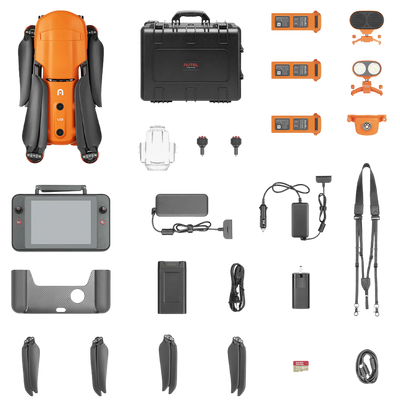
Autel EVO MAX 4T V2: The NDAA-Compliant SAR Powerhouse
The Autel EVO MAX 4T V2 is the choice for SAR programs where NDAA compliance is a procurement requirement and DJI equipment is not eligible. The Scottish Search and Rescue Aerial Association has been operating the EVO MAX 4T in real SAR missions across Scotland's dense forest and mountain terrain, and their operational reports confirm what the specifications suggest: the AI recognition system identifies human heat signatures before operators can do so visually, which is the defining capability in dense canopy environments.
The V2 introduces hot-swappable ABX41-D batteries, battery-in-place detection, and redesigned visual obstacle avoidance with an optimised fisheye lens placement. These are not incremental updates. For a SAR program flying night operations in complex terrain, the hot-swap battery system means the aircraft never fully powers down during an active search, removing the boot-up and GPS acquisition delay between battery cycles.
The A-Mesh 1.0 networking system allows multiple EVO MAX 4T V2 units to share a combined communications network without centralised infrastructure. For large-scale SAR operations covering multiple search sectors with different teams, A-Mesh allows sector commanders to see the feeds from all aircraft in a unified display without deploying a ground relay station.
Key specifications for SAR:
- Thermal Camera: 640x512 radiometric, 9.1mm focal length, 16x digital zoom
- Wide Camera: 48MP 1/2-inch CMOS, ISO up to 64,000, Moonlight Algorithm 2.0 for low-light
- Zoom Camera: 48MP, 10x optical zoom, 160x maximum hybrid zoom, targets visible at 2 km
- Laser Rangefinder: up to 1.14 km, one-click GPS coordinate acquisition
- Flight Time: 42 minutes maximum, hot-swappable batteries
- Transmission Range: 12.4 miles (20 km) via SkyLink 3.0
- Wind Resistance: Level 7, up to 15 m/s
- Obstacle Avoidance: 720 degrees, binocular vision plus millimeter-wave radar
- Operating Temperature: minus 20 to 50 degrees Celsius, wider range than most competitors
- AI Recognition: human, vehicle, and heat source auto-identification and tracking
- A-Mesh Networking: multi-drone coordination without ground relay
- NDAA Compliant: yes
Real deployment context: The EVO MAX 4T V2 suits state and county agencies that have NDAA procurement requirements, need GPS-denied capability for indoor or subterranean search, or run operations where multiple drones must coordinate across sectors. The minus 20 degree Celsius operating floor is also meaningful for teams operating in northern states and mountain environments where the Matrice 4T would be approaching its limits.
Shop the Autel EVO MAX 4T V2 at Scanixx: scanixx.com/products/autel-robotics-evo-max-4t-v2
Autel EVO II Dual 640T Enterprise V3: The Entry Point for SAR Programs
Not every SAR team needs a platform at $7,000 to $10,000. For volunteer teams, smaller departments, and programs building their first drone capability, the Autel EVO II Dual 640T Enterprise V3 delivers 640x512 radiometric thermal imaging at a price point that makes a real budget difference.
The 640T V3 carries a FLIR Boson thermal core alongside an 8K 50MP visible camera, and delivers picture-in-picture monitoring where the thermal and visible feeds overlay in real time on the operator's screen. That dual-feed view is how most SAR operators work: the thermal feed locates the heat signature, the visible feed confirms what it is. Having both on one screen without switching modes reduces the cognitive load on an operator who is simultaneously managing flight, navigating to a target, and communicating with ground teams.
Key specifications for SAR:
- Thermal Sensor: 640x512 FLIR Boson radiometric, sensitivity under 40 mK
- Optical Camera: 8K 50MP RYYB sensor with 16x zoom
- Picture in Picture: simultaneous thermal and visible overlay
- Flight Time: 42 minutes
- Transmission Range: 15 km
- Wind Resistance: Level 8, up to 39 mph, the highest wind rating in its class
- Temperature Measurement: spot, line, area, and isotherm modes
- Operating Temperature: minus 10 to 40 degrees Celsius
- NDAA Compliant: yes
Real deployment context: The 640T V3 is the right choice for a county SAR team or volunteer fire department that needs professional thermal capability, has federal funding restrictions that require NDAA compliance, and is working within a budget under $6,000. The Level 8 wind rating also makes it the strongest performer in coastal and open terrain environments where the Matrice 4T at Level 7 may be grounded more often.
Shop the Autel EVO II Dual 640T Enterprise V3 at Scanixx: scanixx.com/products/autel-robotics-evo-ii-dual-640t-enterprise-bundle-v3
Parrot ANAFI USA GOV Edition: When Blue UAS Certification Is Required
Some SAR programs, particularly those operating within Department of Defense adjacent frameworks or under specific federal grant conditions, need a platform on the Blue UAS Cleared List rather than simply NDAA compliant. The Parrot ANAFI USA GOV Edition covers this requirement.
Designed and assembled in the United States, the ANAFI USA carries 32x optical zoom, a FLIR thermal camera, dual 4K HDR sensors, and end-to-end AES-256 data encryption. It deploys in under 60 seconds from a backpack, which is the practical requirement for SAR operations where the drone team arrives at a trail head and needs to be airborne before the ground team finishes briefing.
Key specifications for SAR:
- Optical Zoom: 32x, 64MP sensor
- Thermal Camera: FLIR-based, visible and thermal simultaneous
- Flight Time: 32 minutes
- Transmission Range: 5 km
- Weight: 500 grams
- Deployment: under 60 seconds from bag to airborne
- Data Security: AES-256 encryption, all data processed on-device
- Compliance: Blue UAS Cleared List, NDAA compliant, TAA compliant
- Manufacturing: assembled in the United States
Real deployment context: The ANAFI USA suits law enforcement SAR teams, federal agency programs, and any operation where the contracting officer specifies Blue UAS certification rather than NDAA compliance alone. The 500-gram weight also makes it one of the most portable professional thermal platforms available, which matters for foot-access SAR operations where every kilogram of gear is carried to the search area.
Shop the Parrot ANAFI USA GOV Edition at Scanixx: scanixx.com/products/parrot-anafi-usa-gov-edition
SAR Drone Regulations in 2026: What Your Team Needs to Know
FAA Part 107. Recreational drone rules do not apply to SAR operations. All commercial and public safety drone flights require either FAA Part 107 certification for each operator, or a Certificate of Waiver or Authorization for public agencies operating under their governmental authority.
Public Aircraft Operations (PAO). Law enforcement agencies, fire departments, and government SAR programs can operate under PAO status, which exempts them from several Part 107 restrictions including the altitude ceiling and some airspace notification requirements. PAO status requires the agency to be a governmental entity and the flight to be in service of a governmental function.
Night operations. Night SAR flights are explicitly covered under current Part 107 rules provided the drone is equipped with an anti-collision light visible from 3 statute miles. All platforms in the Scanixx SAR lineup are equipped or compatible with anti-collision lights meeting this requirement.
Airspace coordination. SAR operations frequently take place in controlled airspace or Temporary Flight Restrictions established by the incident commander. LAANC authorisation handles most routine cases instantly. For active TFRs, coordination with the incident air operations branch is required before launch.
NDAA and Blue UAS compliance. Law enforcement and SAR agencies receiving federal grants must use NDAA-compliant equipment when purchasing with those funds. Agencies with DoD-adjacent procurement requirements need Blue UAS Cleared List status. The relevant grant terms govern which standard applies. Verify with your contracting or grants officer before purchasing if federal funds are involved.
How to Choose the Right SAR Drone for Your Program
Choose the DJI Matrice 4T if:
You run a mixed-mission program covering SAR, inspection, and public safety, and you want the best multi-sensor payload without NDAA restrictions. The 1,800-metre laser rangefinder is the capability that justifies the platform over the competition for night woodland searches.
Choose the Autel EVO MAX 4T V2 if:
NDAA compliance is required and you need the most capable NDAA-compliant thermal platform available. The AI recognition system, 720-degree obstacle avoidance, GPS-denied flight capability, and A-Mesh networking make this the most operationally advanced platform for complex SAR environments.
Choose the Autel EVO II Dual 640T V3 if:
Budget is a real constraint, NDAA compliance is required, and 640x512 radiometric thermal capability is the core requirement. The Level 8 wind rating is a genuine differentiator for coastal and open terrain programs.
Choose the Parrot ANAFI USA GOV Edition if:
Blue UAS Cleared List status is a hard procurement requirement. The portability and 60-second deployment make it the strongest option for foot-access terrain and rapid-deployment protocols.
Frequently Asked Questions About SAR Drones
Note: Add FAQ Schema markup to this section in Shopify for Google rich results.
Can a drone thermal camera see through trees?
Not through solid vegetation, but through gaps and partial canopy. Thermal cameras detect infrared radiation, which travels in straight lines like visible light. Dense, closed canopy blocks thermal imaging the same way it blocks visual cameras. However, thermal imaging detects heat conducted through thinner vegetation, partial gaps in canopy, and subjects on the ground at the edges of tree cover. In operational SAR experience, thermal drones locate subjects in woodland by flying systematic grid patterns at altitudes that allow views through gaps, and by detecting the thermal radiation that subjects emit upward through partial cover.
How far can a SAR drone detect a person at night?
Detection range depends on sensor resolution, altitude, and ambient temperature. A 640x512 thermal sensor on a platform like the Matrice 4T or EVO MAX 4T V2 can detect a person-sized heat signature at distances beyond 300 to 400 metres under typical conditions. At closer ranges, the image provides enough detail to confirm body position and whether the subject is moving. Cold ambient temperatures increase contrast and improve detection range; warm summer nights reduce contrast and reduce effective detection distance.
What thermal resolution do I need for SAR work?
640x512 is the operational standard for professional SAR work. This resolution provides sufficient detail at search altitudes of 50 to 120 metres to distinguish a human heat signature from animals, warm objects, and ground features. Lower resolution sensors at 320x256 are adequate for detecting that something warm is present but often insufficient for confirming it is a person at useful search altitudes.
Do SAR drones work in smoke?
Thermal cameras work through light smoke and haze significantly better than visible cameras because they detect heat rather than reflected light. Heavy, dense smoke with a high particulate load does reduce thermal penetration. However, in most fire-adjacent SAR applications, such as searching ahead of a fire front or after a structure fire, thermal imaging outperforms visible cameras substantially and allows SAR teams to work in conditions where ground visibility is effectively zero.
Can I fly a SAR drone at night without a waiver?
Yes, under current FAA Part 107 rules, night flights are permitted without a waiver provided the aircraft is equipped with an anti-collision strobe light visible from 3 statute miles. This rule change came into effect in 2021. All professional SAR drone platforms include or are compatible with a compliant strobe light. Public agencies operating under PAO status have additional flexibility.
What does NDAA compliance mean for a SAR program?
NDAA compliance means the drone does not use components from manufacturers listed as security risks in the National Defense Authorization Act, primarily Chinese companies including DJI and Autel. For SAR programs purchasing equipment with federal grants or operating under contracts that specify NDAA compliance, non-compliant hardware is not eligible. The Autel EVO MAX 4T V2, Autel EVO II Dual 640T V3, and Parrot ANAFI USA GOV Edition all meet NDAA requirements.
Ready to Equip Your Team?
The decision on which platform to purchase comes down to your specific mission profile, funding source, compliance requirements, and operating environment. Scanixx carries the full professional SAR drone lineup with free US shipping on orders over $599. Our team works directly with public safety agencies on procurement documentation, specification sheets for grant applications, and configuration advice. Contact us at info@scanixx.com to discuss your program's requirements.
Browse all thermal and SAR drones at Scanixx: scanixx.com/collections/thermal-drones