Short version: if your work is paid for with federal money, the rules care about where your drone is made, not just what it can do. An NDAA-compliant drone is one that avoids covered foreign manufacturers, which makes it eligible for federal and federally funded use. This guide explains what that means, how Blue UAS and Green UAS differ, who actually needs a compliant drone, and what your options are in 2026.
What does NDAA-compliant mean?
The National Defense Authorization Act (NDAA) is the annual US defense law. Several recent editions restrict the federal government from buying or operating drones from certain foreign manufacturers. The FY2025 NDAA, in Section 1709, names DJI and Autel specifically. A drone described as NDAA-compliant is built without those covered manufacturers and their critical components, so a federal agency or a federally funded program can procure and fly it.
The key thing to understand is that compliance is about supply chain and country of origin, not flight performance. A compliant drone is not automatically better or worse in the air. It is simply cleared for government use.
Blue UAS vs Green UAS
These two labels come up constantly, and they are related but not the same.
- Blue UAS is a program run by the US Defense Innovation Unit (DIU). It vets drones for cybersecurity and supply-chain trust and approves them for government use. Approved aircraft appear on the Blue UAS Cleared List.
- Green UAS is a certification administered by AUVSI, the industry association. It validates cybersecurity and NDAA compliance for commercial drones and often acts as an on-ramp toward Blue UAS approval.
In practice, both signal a cleared, NDAA-compliant supply chain. Blue UAS is the stricter, government-facing standard, and Green UAS is the commercial-facing path that can lead to it.
Who actually needs a compliant drone?
This is where most of the confusion lives. NDAA restrictions target federal procurement, so the answer depends on whose money you are spending.
- You probably need compliance if you are a federal agency, a state or local agency buying with federal grant money, a contractor on a federally funded project, or a public-safety or infrastructure program with a compliance clause.
- You probably do not need it if you are a private company or an individual buying with your own funds for commercial or recreational work. In that case you can still choose DJI or Autel.
The single most useful question to ask before you buy is simple: where does the money come from? If any of it is federal, plan for a compliant platform.
How this fits the 2026 picture
Since December 2025, DJI and Autel, along with essentially all foreign-made drones, sit on the FCC Covered List, which blocks new models from entering the US market. In January 2026 the FCC issued an exemption that removed Blue UAS and qualified domestic products from that list, alongside a conditional waiver process for other non-US aircraft. For government and grant-funded buyers, the takeaway is clear: compliant platforms are the dependable path forward.
What are my options?
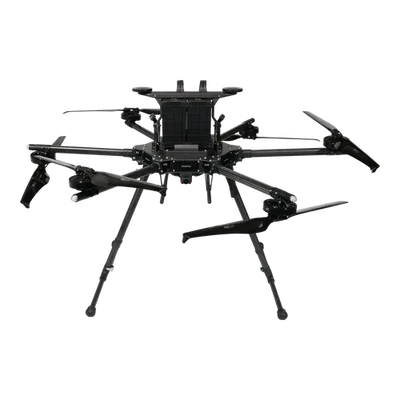
The compliant market has grown well beyond a token alternative. Compliant aircraft such as the Freefly Astro cover mapping and inspection, sensor makers such as Sentera supply NDAA-compliant thermal and multispectral payloads, and agricultural platforms are available for spraying work. You can see the vetted options we carry in our NDAA-compliant collection.
Because compliance status can change as programs update their lists, always confirm a specific model before you commit. The authoritative sources are the DIU Blue UAS Cleared List and the AUVSI Green UAS program, and for any contract, your own agency or grant guidance.
How to verify compliance before you buy
- Confirm your funding source first. That decides whether you need compliance at all.
- Ask the seller for the manufacturer's NDAA or Blue UAS documentation for the exact model and configuration.
- Check the current Blue UAS Cleared List or Green UAS listing for the model.
- For payloads and accessories, confirm the whole system, not just the airframe, meets the requirement.
How Scanixx helps
We match compliant systems to your spec and provide the documentation procurement teams need. Tell us your mission and funding source and we will recommend a platform that clears your requirement. Request a quote to get started.
This guide is general information for 2026, not legal or procurement advice. Compliance programs and lists change, so verify a model's current status with the DIU Blue UAS program, AUVSI Green UAS, and your own agency or grant guidance before purchase.