A salmon farm in the Pacific Northwest runs 12 net pens covering several acres of water. Each pen holds hundreds of thousands of fish worth several million dollars at harvest. The nets keeping those fish in, and predators out, require regular inspection. A single undetected hole in a net can result in a fish escape event that costs the operation its entire stocking density for that pen, plus the regulatory reporting and restocking costs that follow.
Traditionally, that inspection required a diver. Dive operations at commercial fish farms cost between $800 and $2,500 per dive per person, require trained dive supervisors, safety equipment, and favorable weather conditions, and still only cover what a diver can physically reach in a single tank. On a large farm with multiple pens, daily inspections by dive teams are simply not economical.
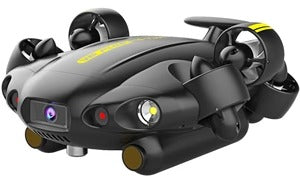
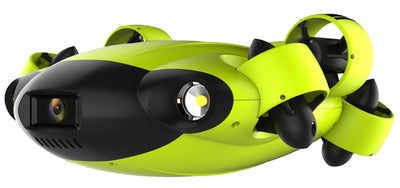
Aquaculture ROVs solve this problem. A compact underwater drone deployed from the dock or a small tender covers a complete net pen inspection in under 30 minutes, produces 4K video documentation of every section of netting, checks anchor lines and mooring systems, and monitors fish behavior and health, all without a diver entering the water. At Scanixx, we carry the QYSEA FiFish and CHASING lineup of underwater drones, which are the platforms aquaculture operators reach for first when transitioning away from dive-dependent inspection programs.
What Aquaculture Operators Actually Use ROVs For
The use cases for underwater drones in fish farming are broader than most operators initially assume. Net inspection is the entry point, but experienced aquaculture ROV operators typically expand into several other inspection and monitoring tasks once they have a platform on site.
Net pen inspection. The primary use case. The ROV flies along the interior and exterior of the net, capturing continuous 4K video that the farm manager reviews for holes, tears, biofouling, and areas where the net has deformed under current pressure or debris load. A complete inspection of a standard salmon pen takes 20 to 40 minutes depending on pen size and ROV model. The same inspection by a dive team takes longer, costs more, and produces no video record unless the diver carries an underwater camera separately.
Stock health monitoring. The ROV enters the pen and surveys the fish population at various depths. Farm managers use the live video feed to assess swimming behavior, body condition, the presence of sea lice or lesions, and feeding response. Stressed, diseased, or oxygen-deprived fish display observable behavioral patterns well before mortality events begin. Early detection through regular ROV monitoring allows intervention before losses escalate.
Mooring and anchor line inspection. Net pens are held in position by mooring systems that include anchor lines, chains, and seabed anchors. These components are subject to abrasion, corrosion, and biofouling, and their failure can result in pen drift or collapse. ROV inspection of mooring components at depth identifies wear and corrosion before it reaches critical levels, supporting a planned maintenance schedule rather than reactive emergency repair.
Seabed condition monitoring. Intensive fish farming produces organic waste that accumulates on the seabed beneath the pens. Regulatory compliance in most jurisdictions requires periodic seabed monitoring to assess the impact of the operation on the benthic environment. An ROV survey of the seabed under and around the pen provides the video and still image documentation that environmental compliance programs require.
Equipment retrieval. Tools, feeding system components, and other equipment that falls into the pen or overboard during maintenance operations are recovered using ROVs equipped with robotic arms. The QYSEA FiFish V6S carries a 5 kg robotic arm as standard equipment, making it the go-to choice for farms where equipment retrieval is a regular operational task.
Predator net inspection. Many farms deploy secondary anti-predator nets around the primary production nets to prevent seal and sea lion incursions. These outer nets require separate inspection programs. The ROV handles both the inner production net and the outer predator net in the same deployment.
QYSEA FiFish V6S: The Aquaculture ROV with a Robotic Arm Standard
The QYSEA FiFish V6S is the most specified underwater drone for professional aquaculture inspection work in the Scanixx lineup. It combines the six-thruster omni-directional movement architecture of the FiFish V6 platform with a 5 kg robotic arm included as standard equipment in the base package. That arm inclusion changes what the drone can do on a fish farm from a passive observer to an active intervention tool.
The six-thruster configuration gives the V6S full lateral movement, the ability to hold station against pen currents without drift, and the control authority to position the camera precisely against specific sections of netting for close inspection. Many competing underwater drones use four or five thrusters and cannot move laterally without turning the aircraft, which makes systematic net inspection significantly harder in the confined space inside a production pen.
- Thrusters: 6, full 360-degree omni-directional movement with lateral strafe capability
- Camera: 4K UHD, 166-degree wide field of view
- Lighting: high-output integrated LEDs for visibility inside pens and at depth
- Robotic Arm: 5 kg gripping force, included as standard
- Battery Life: up to 6 hours continuous operation
- Dive Depth: 100 metres
- Tether: 100 metres included
- VR Control: optional head-tracking immersive control mode
The 6-hour battery life is a meaningful operational advantage for farms running full inspection programs. A complete net pen inspection, seabed survey, mooring line check, and stock monitoring session for a single large pen takes 1.5 to 2.5 hours. With 6 hours of endurance, the V6S covers multiple pens in a single deployment without returning to charge.
Shop the QYSEA FiFish V6S at Scanixx
QYSEA FiFish PRO V6 Plus: When Depth and Measurement Matter
For farms with deep pen installations, offshore cage systems, or operations where documented measurement of net damage is required for insurance or regulatory reporting, the QYSEA FiFish PRO V6 Plus adds critical capabilities beyond what the V6S offers.
The built-in laser scaler measures the actual dimensions of objects in the camera frame with 1 cm accuracy, producing measurement data that can be included directly in inspection reports without manual estimation. A 3 cm hole in a net and a 30 cm hole require different responses. The PRO V6 Plus documents which one it is. The sonar-based distance lock holds the ROV at a consistent standoff distance from the net surface automatically, allowing systematic inspection passes at a controlled camera angle without the operator managing depth manually.
- Dive Depth: 150 metres, covering deeper offshore cage systems
- Laser Scaler: built-in AR laser ruler, accurate to 1 cm for net damage documentation
- Sonar: forward distance lock and downward altitude lock
- Camera: 4K UHD, 166-degree FOV, 6,000 lumens lighting
- Modular Interface: QYSEA Q-Interface supports over 25 attachable extensions
- Tether: 200 metres
- Battery Life: up to 6 hours
Shop the QYSEA FiFish PRO V6 Plus at Scanixx
CHASING GLADIUS MINI: Accessible ROV for Smaller Aquaculture Operations
Not every fish farm operation requires a professional-grade six-thruster platform. For smaller operations, freshwater fish farms, shellfish and oyster producers, and farms that want to start an ROV program before committing to a full professional system, the CHASING GLADIUS MINI delivers 4K video quality and 100-metre depth rating at a significantly lower price point.
The GLADIUS MINI uses five thrusters, which provides good depth and forward movement control but does not offer the full lateral strafe capability of the QYSEA six-thruster platforms. For straight-line net inspection runs and general stock monitoring, the five-thruster configuration is adequate. For complex confined-space maneuvers inside production pens with strong current, the six-thruster advantage becomes more relevant.
- Camera: 4K UHD with electronic image stabilisation, 12MP stills
- Dive Depth: 100 metres
- Tether: available in 100m and 200m versions
- Battery Life: up to 4 hours
- Lighting: dual 1,200 lumen LEDs
- Thrusters: 5, depth lock included
Shop the CHASING GLADIUS MINI at Scanixx
The ROI Case for Aquaculture ROVs
The cost comparison between dive-based inspection and ROV-based inspection is straightforward for most aquaculture operations.
A single dive inspection of one net pen, including mobilization, dive supervisor, diver costs, and decompression time, typically costs $800 to $2,500 depending on location and water depth. For a 12-pen farm running weekly inspections across the full farm, that is $9,600 to $30,000 per month in dive inspection costs alone, before adding the cost of any remediation work the inspections identify.
A QYSEA FiFish V6S costs approximately $4,500. After the initial equipment purchase, the ongoing cost of ROV inspections is the operator's time, typically 30 to 45 minutes per pen, plus tether management. A farm manager who incorporates ROV inspection into their daily routine covers the entire farm several times per week at no incremental cost. The equipment pays for itself within the first month of operation for most farms currently running dive-dependent inspection programs.
The production benefit compounds the direct cost saving. Early detection of net damage, disease indicators, mooring wear, and seabed issues through more frequent monitoring translates directly to lower production losses. A single prevented escape event on a salmon farm typically represents a value exceeding the cost of the ROV many times over.
Regulatory Context for Aquaculture ROV Use in the US
Underwater ROVs used within privately operated fish farm enclosures in the United States do not require FAA certification, as they operate underwater rather than in navigable airspace. No pilot license is required to operate an ROV for private aquaculture purposes.
Operators deploying ROVs in navigable waterways outside their own enclosures, or using drones for aerial surveillance above the farm, should confirm the applicable USACE and state regulations for their specific location. Some coastal and tidal water operations may require permits for ROV deployment from the relevant harbor authority or state fisheries agency.
Frequently Asked Questions About Aquaculture ROVs
What is the best underwater drone for fish farm inspection?
For professional aquaculture inspection, the QYSEA FiFish V6S is the most capable option at its price point, combining six-thruster omni-directional movement, 4K camera quality, 6-hour battery life, and a standard robotic arm for equipment retrieval. For operations that need documented measurement of net damage for insurance or compliance reporting, the QYSEA FiFish PRO V6 Plus adds a built-in laser scaler and 150-metre depth capability. For smaller operations and first-time ROV buyers, the CHASING GLADIUS MINI offers 4K quality at a more accessible price.
Can an underwater drone detect holes in fish nets?
Yes. 4K video from a compact ROV with good lighting provides sufficient resolution to identify holes, tears, abrasion damage, and areas of biofouling on net pen mesh. The QYSEA FiFish PRO V6 Plus adds a laser measurement system that documents the size of detected damage to 1 cm accuracy, which is valuable for regulatory reporting and insurance documentation.
How long does an ROV net pen inspection take?
A complete inspection of a standard salmon pen, covering the interior walls, floor net, predator net, and mooring connections, takes 20 to 45 minutes depending on pen size, ROV model, and current conditions. The QYSEA V6S with its lateral movement capability completes systematic passes more efficiently than four or five-thruster platforms that require turning to change inspection direction.
Do I need a licence to operate an underwater drone at a fish farm?
No license is required to operate an ROV for private aquaculture inspection purposes within your own enclosures in the United States. The relevant regulations governing underwater ROV use are those of the waterway authority for the body of water where you operate. Confirm requirements with your state fisheries agency and the US Army Corps of Engineers for your specific location if operating in navigable waters.
Can aquaculture ROVs work in strong currents?
Six-thruster ROVs with lateral movement capability, such as the QYSEA FiFish V6 series, handle stronger currents more effectively than four or five-thruster platforms because they can hold station without rotating. The QYSEA PRO V6 Plus sonar-based distance lock maintains a consistent standoff from the net surface even when current is pushing the ROV laterally. In very strong tidal currents, a heavier tether may be required to prevent the tether itself from pulling the ROV off course.
Ready to Reduce Your Dive Costs?
Whether you manage a salmon farm, a shellfish operation, or an offshore cage system, the right underwater drone changes your inspection economics from day one. Scanixx carries the QYSEA FiFish and CHASING lineup with free US shipping on orders over $599. Contact us at info@scanixx.com to discuss which platform fits your farm size, depth requirements, and inspection program.