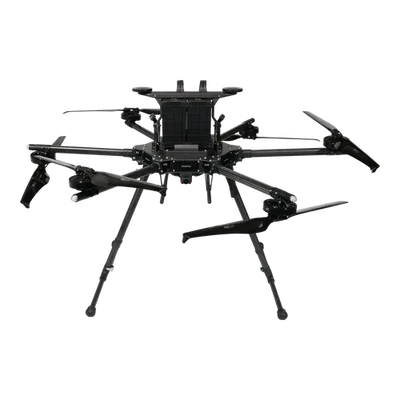
Something changed on December 22, 2025 that affects every drone operator working on federally funded projects in the United States. The American Security Drone Act, included in the FY2024 NDAA, came into full effect on that date. From that point forward, federal agencies cannot operate drones sourced from covered foreign entities, and contractors or grantees using federal funds face the same restriction. The grace period is over.
For operators who have built their workflows around DJI equipment, that is a significant problem. DJI and Autel were both added to the FCC Covered List on December 23, 2025, blocking new equipment authorizations. Federal agencies and federally funded programs cannot procure or operate either brand going forward.
This guide explains what Blue UAS actually means, how it differs from NDAA compliance, which operators are affected, and what the practical options are for inspection contractors, public safety teams, and enterprise operators who need to stay compliant in 2026.
What Happened and Why It Matters Now
The restrictions on Chinese-made drone hardware have been building for years. Section 848 of the FY2020 NDAA first prohibited the Department of Defense from purchasing drones manufactured by companies including DJI. Section 817 of the FY2023 NDAA tightened those rules further. The American Security Drone Act in FY2024 extended the prohibition government-wide and set a deadline.
That deadline was December 22, 2025.
The practical consequence is that any drone operation receiving federal funding now faces a binary choice: fly compliant hardware, or lose access to federal contracts, grants, and programs. This affects a much wider group than most operators initially assumed. It includes state and local law enforcement agencies receiving federal grants. It includes utility inspectors working under federally funded infrastructure programs. It includes contractors on federally funded construction sites using drone surveying. It includes search and rescue teams operating under FEMA or Department of Homeland Security programs.
If any part of your operating budget, your client's budget, or the program you are working under involves federal money, the restriction applies to you.
Blue UAS, NDAA Compliance, and Green UAS: What the Difference Actually Is
These three terms appear constantly in procurement discussions and are frequently confused with each other. They are not interchangeable.
NDAA compliance is a legal baseline. A drone is NDAA-compliant if it avoids components and manufacturers from countries designated as security threats, primarily China, as defined in the relevant NDAA sections. Critically, NDAA compliance is largely self-declared by manufacturers. There is no independent verification requirement. A manufacturer can describe their product as NDAA-compliant without any third party confirming it. That matters when procurement officers are trying to justify purchases to auditors.
Blue UAS is a step beyond NDAA compliance. The Blue UAS Cleared List is managed by the Defense Contract Management Agency (DCMA), which took over from the Defense Innovation Unit (DIU). To appear on the Blue UAS Cleared List, a drone must meet NDAA requirements and pass independent cybersecurity verification. That verification includes penetration testing to confirm the platform does not exfiltrate data, create exploitable network vulnerabilities, or route information through foreign servers. As of early 2026, the Blue UAS Cleared List includes more than 50 platforms. For Department of Defense procurement, Blue UAS is effectively required.
Green UAS is a separate certification pathway focused on cybersecurity for non-DoD government and commercial operators. It uses third-party assessors from an AUVSI-managed program and provides similar assurance for agencies and enterprises that do not have the DoD requirement but want independently verified security credentials.
The relationship matters for buyers: NDAA compliance is the legal floor, Blue UAS is the DoD standard, and Green UAS is the commercial and non-DoD government equivalent. A drone can be NDAA-compliant without being Blue or Green certified. Blue and Green UAS platforms have both supply chain and cybersecurity formally verified by a recognised third party.
Who Is Affected and Who Is Not
The clearest way to determine whether these rules apply to your operation is to ask one question: does any part of this programme, contract, or budget involve federal money?
Directly affected:
Government agencies at any level using federal funds. Federal contractors and subcontractors on government projects. Grantees receiving federal grants for public safety, infrastructure, or environmental programs. Utilities operating under federally regulated or federally funded infrastructure programs. First responder agencies receiving Department of Homeland Security or FEMA equipment grants.
Not directly affected by federal rules, though supply chain concerns still apply:
Private commercial operators with no federal funding. Commercial inspection companies working entirely on private contracts. Agricultural operators using drones on privately funded farm programs. Content creators and media companies.
Private operators are not bound by the federal procurement rules, but they operate in a market that is shifting rapidly. Enterprise clients in energy, construction, and utilities are increasingly requiring NDAA compliance from contractors as standard contract language, regardless of federal funding. The insurance market is beginning to follow the same direction.
The Blue UAS Cleared List: What Is On It
The Blue UAS Cleared List has grown from five platforms in 2020 to more than 50 by early 2026. Notable platforms that have appeared on the list include systems from Freefly Systems, Skydio, ACSL, Parrot, Teal Drones, AeroVironment, Eagle NXT (agEagle), and Inspired Flight Technologies. The Skydio X10D topped a Department of Homeland Security assessment of Blue UAS platforms for first responders, scoring the highest rating across capability, deployability, usability, and maintainability.
Freefly Systems' Astro and Astro Max platforms hold Blue UAS status and represent the modular payload approach for operators who need to swap sensors between missions. The Astro Max in particular supports the Sentera 6X multispectral sensor, making it a viable platform for precision agriculture operators who need both NDAA compliance and professional-grade crop health data.
It is important to note that the Blue UAS Cleared List is not static. Platforms are added and removed as manufacturers change supply chains, ownership structures, or firmware. Treating compliance as a one-time purchase check rather than a periodic review is one of the most common errors procurement teams make. A drone that was compliant at purchase may not remain so if the manufacturer makes material changes to its components or software infrastructure.
NDAA-Compliant Options at Scanixx: The Autel EVO II Dual 640T
Scanixx carries the Autel EVO II Dual 640T Enterprise Bundle V3, which is NDAA-compliant hardware designed for professional inspection, public safety, and enterprise thermal imaging work. It is the practical choice for operators who need to move away from DJI for federally adjacent work without stepping up to Blue UAS-level pricing.
The Autel EVO II Dual 640T V3 delivers:
- Thermal Sensor: 640x512 radiometric with sensitivity under 40 mK, using the FLIR Boson core, an American-made sensor
- Optical Camera: 8K visual with 16x digital zoom
- Wind Resistance: Level 8 at up to 39 mph, which meaningfully exceeds the DJI Mavic 3 Enterprise at Level 5
- Flight Time: up to 42 minutes
- No Geofencing: Autel does not enforce software-controlled no-fly zones, which matters for operators working near infrastructure
- Radiometric Temperature Measurement: spot, line, area, and isotherm modes for inspection documentation
- Thermal Sensitivity: under 40 mK, detecting temperature differences below half a degree Celsius
At $4,799 for the Rugged Bundle, the Dual 640T V3 delivers 640x512 radiometric thermal imaging at a price point approximately $1,900 below comparable DJI thermal platforms with the same resolution. For inspection contractors transitioning away from DJI on federally adjacent contracts, this represents the most accessible professional thermal platform with clean NDAA supply chain credentials.
The FLIR Boson thermal core is a meaningful distinction. FLIR is an American company with a long history of supplying thermal sensors to US defense and government programs. For procurement officers who need to document the origin and security credentials of their equipment in contract compliance paperwork, the FLIR core is a specific, verifiable point of differentiation.
Important note on Blue UAS status: The Autel EVO II Dual 640T V3 is NDAA-compliant but is not currently listed on the DCMA Blue UAS Cleared List. For operators whose contracts specifically require Blue UAS certification rather than NDAA compliance, it is essential to verify the exact requirement with your contracting officer. For federally funded programs that require NDAA compliance without the Blue UAS certification specifically, the EVO II 640T V3 is an appropriate platform.
Shop the Autel EVO II Dual 640T Enterprise Bundle V3 at Scanixx: scanixx.com/products/autel-robotics-evo-ii-dual-640t-enterprise-bundle-v3
Real-World Use Cases for NDAA-Compliant Thermal Drones in 2026
Critical Infrastructure Inspection for Federal Contractors
Bridge inspection, power line maintenance, and pipeline monitoring programs that receive federal infrastructure funding are among the highest-volume use cases for compliant drone hardware in 2026. A contractor inspecting a federally funded bridge rehabilitation project cannot use DJI equipment under the current rules. The Autel EVO II Dual 640T V3 provides the thermal and optical capability needed to inspect structural elements, identify delamination on concrete surfaces through thermal contrast, and document conditions at the resolution required for engineering reports.
State and Local Public Safety Agencies
Police departments and fire departments that receive DHS equipment grants are now subject to the same restrictions as federal agencies when using grant-funded equipment. A fire department that purchased DJI equipment with Staffing for Adequate Fire and Emergency Response (SAFER) grant funds faces the prohibition. The transition to NDAA-compliant hardware for thermal search and rescue, fire perimeter monitoring, and tactical overwatch is a procurement cycle that is playing out across hundreds of agencies simultaneously in 2026.
The Autel EVO II 640T V3's Level 8 wind resistance is particularly relevant for public safety use cases. Urban environments with building interference and coastal jurisdictions with regular afternoon winds regularly exceed the Level 5 rating on comparable DJI platforms. For fire operations where the drone needs to hold position in heat-generated air movement near a structure, the additional wind rating is a practical operational advantage.
Utility and Energy Sector Inspection
Electric utilities operating under regulatory frameworks that reference federal security guidance, and those that have received funding under the Infrastructure Investment and Jobs Act for grid modernisation, face increasing pressure to document the compliance status of their operational technology including drones. Transmission line inspection, substation thermal scanning, and solar farm monitoring for federally funded renewable projects all fall within the affected scope.
The combination of radiometric thermal imaging and NDAA-compliant hardware positions the Autel EVO II 640T V3 as a direct replacement for DJI thermal platforms in these utility inspection workflows. The RTK variant adds georeferenced positioning, which utilities need for asset management databases that track fault locations against specific GPS coordinates on their infrastructure maps.
Shop the Autel EVO II Dual 640T RTK at Scanixx: scanixx.com/products/autel-robotics-evo-ii-pro-6k-rtk-rugged-bundle-v3
Federal Building and Facility Management
General Services Administration-managed federal buildings and Department of Defense facilities that use drones for rooftop inspection, building envelope surveys, and HVAC system thermal monitoring need compliant hardware at every point in the inspection chain. The picture-in-picture mode on the Autel 640T, which overlays the thermal feed on the visible light feed in real time, is particularly useful for facility inspection workflows where the operator needs to correlate thermal anomalies with specific architectural features during the flight rather than in post-processing.
Transition Planning: Practical Steps for Operators Moving Away From DJI
The transition from DJI to NDAA-compliant hardware is not just a purchasing decision. It affects training, standard operating procedures, and data workflows.
Audit your current inventory. Identify which aircraft in your fleet were purchased with federal funds or are used on federally funded programs. Those aircraft are subject to the December 2025 prohibition.
Review your contracts. Check for NDAA compliance language in current and pending contracts. Increasingly, prime contractors are passing down compliance requirements to subcontractors. A subcontract awarded six months ago may now contain language that prohibits DJI equipment even if it did not when the contract was signed.
Verify the specific requirement. NDAA compliance and Blue UAS certification are different standards. Confirm with your contracting officer which applies to your programme before purchasing replacement hardware. Buying NDAA-compliant hardware for a programme that requires Blue UAS certification wastes the procurement budget.
Plan for retraining. Controllers, workflows, and mission planning software differ between platforms. Budget for operator retraining when switching from DJI to Autel or other NDAA-compliant hardware. The operational differences are manageable but require structured familiarisation flights before deploying on live contracts.
Document everything. Maintain records of the compliance credentials of your hardware, the supply chain documentation provided by the manufacturer, and any third-party certifications applicable to your specific procurement requirement. These records will be requested during contract audits.
Frequently Asked Questions About Blue UAS and NDAA Compliance in 2026
Note: Add FAQ Schema markup to this section in Shopify for Google rich results.
Can I still fly my DJI drone if I already own it?
Non-federal private commercial operators who do not receive federal funding can continue to use previously purchased DJI equipment. The prohibition applies to federal agencies and to federally funded programmes. If your operation involves no federal money at any point in the contract chain, the procurement restriction does not apply to you. Check whether any of your clients apply NDAA compliance requirements by contract even for private programmes, as this is becoming more common.
What is the difference between NDAA compliance and Blue UAS certification?
NDAA compliance is a supply chain standard: the drone must not use components or manufacturers from designated foreign countries, primarily China. It is largely self-declared. Blue UAS certification adds independent cybersecurity verification, including penetration testing, to confirm the platform does not create data security vulnerabilities. For DoD procurement, Blue UAS is required. For other federal and federally funded programmes, NDAA compliance may be sufficient, but verify the specific requirement with your contracting officer.
Is the Autel EVO II Dual 640T on the Blue UAS list?
As of the date of this publication, the Autel EVO II Dual 640T V3 is NDAA-compliant but is not listed on the DCMA Blue UAS Cleared List. It is appropriate for programmes that require NDAA compliance without the specific Blue UAS certification requirement. Operators with contracts that specifically require Blue UAS should verify their programme requirements before purchasing.
Why was DJI banned from federal use?
DJI was prohibited from federal procurement under a series of NDAA provisions from 2020 through 2024 because the company is Chinese-owned, operates cloud infrastructure on Chinese servers, and uses components sourced within China. The specific concern is that operational data including flight paths, GPS coordinates of inspection targets, imagery, and sensor data could be accessible to Chinese government entities. The American Security Drone Act that came into full effect on December 22, 2025 extended this prohibition from the Department of Defense to all federal agencies and federally funded programmes.
How do I verify that a drone is NDAA-compliant?
Request documentation of the supply chain from the manufacturer. Ask specifically which components are sourced from outside designated foreign countries and whether any third-party assessors have verified the compliance claim. Platforms on the Blue UAS Cleared List or Green UAS programme have had supply chain compliance independently verified. For self-declared NDAA compliance, you are relying on the manufacturer's documentation. Keep records of what documentation you received as part of your own compliance audit trail.
Ready to Transition Your Fleet?
The regulatory landscape for drone procurement has changed permanently. Operators who plan their transitions now are ahead of the compliance cycle rather than reacting to a disqualifying audit finding. Scanixx carries the Autel EVO II Dual 640T Enterprise Bundle V3 for operators making the move to NDAA-compliant thermal inspection hardware, with free US shipping on orders over $599. Contact us at info@scanixx.com to discuss your specific compliance requirements and which configuration fits your programme.
Browse NDAA-compliant enterprise drones at Scanixx: scanixx.com/collections/enterprise-drones