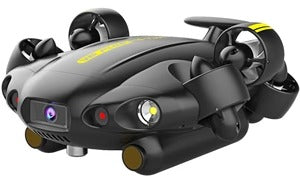
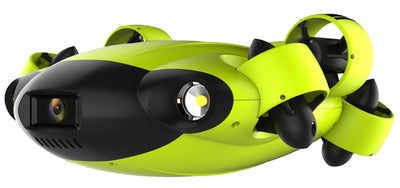
Most people discover underwater drones the same way: they see footage of a coral reef, a shipwreck, or a harbour inspection and immediately want to know how it was filmed. The answer is almost always a compact remotely operated vehicle tethered to the surface, controlled by a person with a standard game controller, watching a live 4K feed from below.
That technology is no longer exotic. In 2025, professional-grade underwater drones are accessible enough for serious hobbyists, advanced enough for commercial inspection work, and capable enough to replace divers in a growing list of applications. At Scanixx, we carry the full QYSEA FiFish and CHASING lineup. This guide explains how they compare, which model fits which use case, and what separates an underwater drone from an underwater camera on a stick.
What Is an Underwater Drone and How Does It Work?
An underwater drone, technically called a Remotely Operated Vehicle or ROV, is a waterproof robot with thrusters, cameras, and lights, connected to the operator by a tether. The tether carries power down and video signal back up, which is why underwater drones do not have the range limitations of aerial drones. Instead of battery anxiety, you have tether length, and the best consumer ROVs come with 100 to 200 metres of cable.
The thrusters give the ROV movement in all directions. Entry-level models use four or five thrusters and move forward, backward, and vertically. Professional models use six thrusters arranged to give six full degrees of freedom, meaning the ROV can roll, tilt, strafe sideways, and hold a precise angle against a current. That six-degrees-of-freedom capability is what separates inspection-grade ROVs from exploratory ones, and it is the primary reason the QYSEA FiFish line has earned its reputation in professional circles.
The camera system sends live video to a screen on the surface, usually a smartphone, tablet, or dedicated display on the controller. Better systems record 4K directly to an onboard SD card while simultaneously streaming to the operator, which means footage quality is not limited by the bandwidth of the tether connection.
Why Underwater Drones Are Replacing Divers for Inspection Work
Sending a diver down costs money before anyone enters the water. Training, certification, safety supervision, equipment rental, and insurance all add up before the inspection itself begins. For many routine tasks, such as checking a hull for biofouling, inspecting a pier support, or surveying the bed of a reservoir, the actual inspection takes twenty minutes and the logistics take a day.
An underwater drone removes most of that overhead. One operator with a waterproof pelican case, a tethered ROV, and a laptop can conduct a hull inspection at a working marina in the time it takes a dive team to gear up. The footage is recorded in 4K, the GPS coordinates of points of interest can be logged, and the operator never gets wet.
This is why the underwater drone market is growing at 16.5 percent annually and is projected to reach $24 billion by 2033. Infrastructure inspection, offshore energy, aquaculture, maritime insurance, and search and rescue are all driving professional adoption faster than the recreational side of the market.
QYSEA FiFish PRO V6 Plus: The Professional Standard
Who It Is Built For
The QYSEA FiFish PRO V6 Plus is the reference platform for professional underwater inspection and advanced ROV work. It is not a beginner drone. It is designed for operators who need reliable performance at 150 metres depth, precise semi-automatic station keeping in currents, and the ability to attach specialist tools to the ROV without switching platforms.
Key Specifications and Features
- Dive Depth: 150 metres (490 feet)
- Thrusters: 6, providing full 6 degrees of freedom
- Camera: 4K UHD, 166-degree FOV, 6000 lumens integrated lighting
- Stabilisation: Q-Motor system with close-loop enhanced stabilisation algorithm
- Sonar: forward distance lock and downward altitude lock in real time
- Laser Scaler: built-in AR laser ruler accurate to 1 cm for underwater measurement
- Positioning: optional Underwater Quick Positioning System (U-QPS) for real-time location tracking
- Modularity: QYSEA Q-Interface supports over 25 attachable extensions
- Tether: 200 metres
What Makes the PRO V6 Plus Different
Most underwater drones let you look at things. The V6 Plus lets you measure, manipulate, and document them. The built-in laser scaler gives you precise size references on cracks, corrosion patches, or biological growth directly in the footage, which is exactly what an inspection report requires. The sonar-based distance and altitude lock means the ROV holds a consistent standoff distance from a wall or structure automatically, freeing the operator to focus on what they are looking at rather than fighting drift.
The modular Q-Interface is the other major differentiator. Inspection cameras, robotic arms, water sampling systems, and other specialist tools attach without any modification to the ROV body. A single V6 Plus can serve as an inspection platform one day and a recovery tool the next.
Shop the QYSEA FiFish PRO V6 Plus at Scanixx: scanixx.com/products/qysea-fifish-pro-v6-plus-professional-4k-underwater-rov-with-150-m-depth-6-h-battery
QYSEA FiFish V6: Industrial Capability at a More Accessible Price
Who It Is Built For
The FiFish V6 is the foundation of the QYSEA lineup. It delivers the same six-thruster omni-directional architecture as the V6 Plus with a 100-metre depth rating and 4K camera. For teams doing routine inspection work, underwater filming, or recreational diving and wreck exploration, the V6 offers professional performance without the full V6 Plus price tag.
Key Specifications and Features
- Dive Depth: 100 metres (328 feet)
- Thrusters: 6, full 360-degree omni-directional movement
- Camera: 4K 30fps, 166-degree wide angle, 4000 lumens lighting
- Battery Life: up to 270 minutes on a single charge
- VR Support: immersive head-tracking control via VR headset
- Controller: smart controller with HDMI output for live display
The 270-minute battery life is one of the most practical advantages the V6 has over most competitors. Long inspection dives, multi-structure surveys, and extended filming sessions all benefit from not having to resurface and recharge after 90 minutes.
Shop the QYSEA FiFish V6 Underwater ROV at Scanixx: scanixx.com/products/qysea-fifish-v6-underwater-robot-rov-4k-camera-vr-control
QYSEA FiFish V6S: The V6 with a Robotic Arm
Who It Is Built For
The V6S takes the V6 platform and adds a robotic arm with 5 kg of gripping force as standard equipment in the package. For operators who need to retrieve small objects, place sensors, take physical samples, or manipulate underwater equipment, the V6S eliminates the need to send a diver for tasks that are fundamentally simple but hard to reach.
Key Specifications and Features
- All V6 specifications, plus:
- Robotic Arm: included as standard, 5 kg gripping force
- Use Cases: object retrieval, sample collection, equipment positioning, scientific tasks
- Battery Life: 6 hours
The robotic arm changes what the drone is for. Without it, you are observing. With it, you are interacting. For aquaculture farms checking pen nets, marina operators recovering lost equipment, or research teams collecting biological samples, the V6S is the most capable affordable tool available.
Shop the QYSEA FiFish V6S Underwater Drone at Scanixx: scanixx.com/products/qysea-fifish-v6s-professional-underwater-drone-4k-rov
CHASING DORY: The Underwater Drone for Beginners
Who It Is Built For
The CHASING DORY is the entry point to underwater drone ownership. It is palm-sized, weighs under 1 kg, and connects to a smartphone via a Wi-Fi buoy floating on the surface. There is no dedicated controller and no heavy case to carry. It fits in a backpack alongside a snorkel and a towel.
For recreational users, travel divers, and people who want to explore shallow reef environments or harbour walls without committing to a professional system, the DORY delivers genuine underwater footage at a price that removes the barrier to entry.
Key Specifications and Features
- Dive Depth: 15 metres
- Camera: 1080p Full HD
- Lighting: 450 lumens
- Tether: 15 metres via Wi-Fi buoy
- Control: smartphone app only
- Weight: under 1 kg
The DORY is honest about what it is. It is not an inspection tool. The 15-metre depth limit and 1080p camera put a ceiling on what it can do professionally. What it does well is make underwater video accessible to anyone who has never operated an ROV before.
Shop the CHASING DORY Underwater Drone at Scanixx: scanixx.com/products/chasing-dory-underwater-drone-palm-sized-1080-fhd-rov
CHASING GLADIUS MINI: 4K Performance in a Portable Package
Who It Is Built For
The GLADIUS MINI sits between the DORY and the professional QYSEA lineup. It delivers 4K video, reaches 100 metres depth, and comes with up to 200 metres of tether. For serious recreational users, underwater photographers, yacht owners, and inspection teams on limited budgets, the GLADIUS MINI delivers most of what matters at a mid-range price.
Key Specifications and Features
- Dive Depth: 100 metres (328 feet)
- Camera: 4K UHD with electronic image stabilisation (EIS), 12MP stills
- Lighting: dual 1200 lumen LED (2400 total in newer bundles)
- Tether: available in 100m and 200m versions
- Speed: 4 knots maximum
- Battery Life: up to 4 hours
- Thrusters: 5
- Depth Lock: one-touch depth hold
- Tilt Lock: adjustable 45-degree camera lock
The 4-hour battery life and direct-connect controller are the GLADIUS MINI's practical strengths. The five-thruster configuration gives good depth and horizontal control, though it lacks the full lateral movement of the six-thruster QYSEA platforms. For most recreational and semi-professional use cases, that limitation is irrelevant.
Shop the CHASING GLADIUS MINI Underwater Drone at Scanixx: scanixx.com/products/chasing-gladius-mini-underwater-drone-4k-omnidirectional-rov
CHASING M2: Professional ROV for Underwater Filmmakers
Who It Is Built For
The CHASING M2 is built for underwater filmmakers and serious professional operators who want CHASING's platform at full capability. With four vertical and four horizontal thrusters in an eight-thruster configuration, the M2 delivers extremely stable positioning in challenging conditions. For documentary filmmakers, commercial video production, and operators working in tidal zones or open water, the M2 provides the stability that allows long, clean takes at depth.
Key Specifications and Features
- Dive Depth: 100 metres
- Thrusters: 8 (4 horizontal, 4 vertical)
- Camera: 4K with GoPro mounting option
- Tether: up to 200 metres
- Robotic Arm: available as optional accessory
- Use Cases: professional filming, reef survey, inspection, content creation
Shop the CHASING M2 Underwater Drone at Scanixx: scanixx.com/products/chasing-m2-underwater-drone-omni-movement-4k-rov
Which Underwater Drone Is Right for You?
Choose the QYSEA FiFish PRO V6 Plus if:
- You do professional inspection work requiring documented measurements and precise positioning
- Depth below 100 metres is part of your operations
- You need a modular platform that accepts specialist tools via the Q-Interface
- Sonar-based distance holding and automatic station keeping matter to your workflow
Choose the QYSEA FiFish V6 if:
- You want professional six-thruster performance at a lower price than the V6 Plus
- 100-metre depth and 4K quality cover your use cases
- Long dive times matter more than specialist tooling
Choose the QYSEA FiFish V6S if:
- You need a robotic arm included in the base kit for retrieval or manipulation work
- Aquaculture, scientific sampling, or equipment recovery is part of your operation
Choose the CHASING DORY if:
- You are new to underwater drones and want an affordable, genuinely portable entry point
- Shallow reef diving, harbour exploration, or holiday use is your primary application
Choose the CHASING GLADIUS MINI if:
- You want 4K quality and 100-metre depth without paying for professional-grade features
- You film underwater for recreation, travel content, or semi-professional work
- A 4-hour battery life matters more than full omni-directional movement
Choose the CHASING M2 if:
- You produce professional underwater video and need maximum stability at depth
- Eight-thruster positioning in challenging conditions is a priority
Underwater Drone Use Cases: Where ROVs Are Making a Real Difference
Hull and Boat Inspection
Biofouling, propeller damage, and hull integrity checks are routine tasks for marina operators, yacht owners, and commercial shipping companies. A dive team requires advance scheduling, safety supervision, and water that is clear enough to see in. An underwater drone with good lighting works in murky harbour conditions and produces footage that can be reviewed and shared with insurance assessors or maintenance crews immediately after the dive.
Infrastructure Inspection
Bridge supports, dam walls, harbour walls, and jetty piles all require periodic underwater inspection. Traditional approaches involve divers or remotely operated cameras on poles with limited reach. A tethered ROV with depth lock and distance hold can systematically cover a structure in a single session, generating video evidence that supports maintenance decisions and regulatory compliance reports.
Aquaculture
Fish farm operators use underwater drones to inspect pen nets for damage, monitor fish health without disturbing stock, check anchor lines and mooring systems, and assess sediment build-up on the seabed beneath cages. The robotic arm on the V6S adds the ability to clear net obstructions or retrieve fouled equipment without deploying a diver.
Search and Recovery
Objects dropped from boats, overboard equipment, and accident scene evidence are all retrieved with underwater drones that would previously have required a dive team. For law enforcement, marine salvage, and private recovery operations, an ROV covers ground faster than a diver and produces a visual record of the search.
Underwater Filmmaking and Content Creation
Reef exploration, marine wildlife footage, and wreck documentation all benefit from platforms that can hold a stable shot at depth. The QYSEA and CHASING platforms produce 4K footage with onboard stabilisation that competes with footage from purpose-built cinema ROVs costing many times more.
Frequently Asked Questions About Underwater Drones
Note: Add FAQ Schema markup to this section in Shopify for Google rich results.
What is the difference between an underwater drone and an ROV?
The terms are used interchangeably in the consumer market. Technically, ROV stands for Remotely Operated Vehicle and refers to any vehicle operated via tether from the surface. Underwater drone is the consumer-friendly name for the same category of product. All QYSEA FiFish and CHASING models sold at Scanixx are tethered ROVs.
How deep can consumer underwater drones go?
Entry-level models like the CHASING DORY dive to 15 metres. Mid-range models like the CHASING GLADIUS MINI and QYSEA FiFish V6 reach 100 metres. The QYSEA FiFish PRO V6 Plus reaches 150 metres. Professional work-class ROVs used in offshore energy go to 300 metres and beyond, but these are industrial systems in a different price category.
Do underwater drones work in murky or low-visibility water?
Yes. All professional underwater drones carry their own lighting, which means visibility depends on the power of the onboard LEDs rather than ambient light or water clarity. The QYSEA V6 carries 4000 lumens and the PRO V6 Plus carries 6000 lumens. In genuinely turbid water, reduced visibility affects all systems equally, but the onboard lights provide working illumination that divers would also rely on in the same conditions.
Can underwater drones be used in saltwater?
Yes. All QYSEA and CHASING models are designed and tested for saltwater use. The tether, connectors, and body seals are rated for marine environments. Rinsing the ROV and tether with fresh water after saltwater use is standard practice that extends component life, just as with any marine equipment.
How long does the tether need to be?
Tether length determines how far from your deployment point the ROV can travel horizontally as well as vertically. For diving to 50 metres depth, you need at least 50 metres of tether for the vertical run plus additional length for horizontal travel. A 100-metre tether gives you roughly 50 metres of depth and 50 metres of horizontal range, or shallower dives with greater range. Models at Scanixx are available in 100-metre and 200-metre tether configurations.
Do I need a licence to operate an underwater drone?
In the United States, no specific licence is required for recreational underwater drone operation. Commercial use in navigable waterways may require permits from the US Army Corps of Engineers or local harbour authorities depending on location. Always check local regulations before deploying in restricted areas, shipping lanes, or near harbour infrastructure.
Ready to Explore What Is Below the Surface?
Whether you are inspecting hull integrity, surveying a reef, or building a professional inspection service, the right underwater drone transforms what is accessible, safe, and economically viable. Scanixx carries the full QYSEA FiFish and CHASING lineup with free US shipping on orders over $599. Contact us at info@scanixx.com to discuss which platform fits your application.
Browse all underwater drones at Scanixx: scanixx.com/collections/underwater-drones